
Now Reading: Behringer UB-1 MICRO: Portable Analog with an 80s Soul
-
01
Behringer UB-1 MICRO: Portable Analog with an 80s Soul
Here’s a fully rewritten English version in my own words (not a summary, not a translation line-by-line), keeping the meaning and structure but with fresh wording and flow:
Behringer UB-1 MICRO: Portable Analog with an 80s Soul
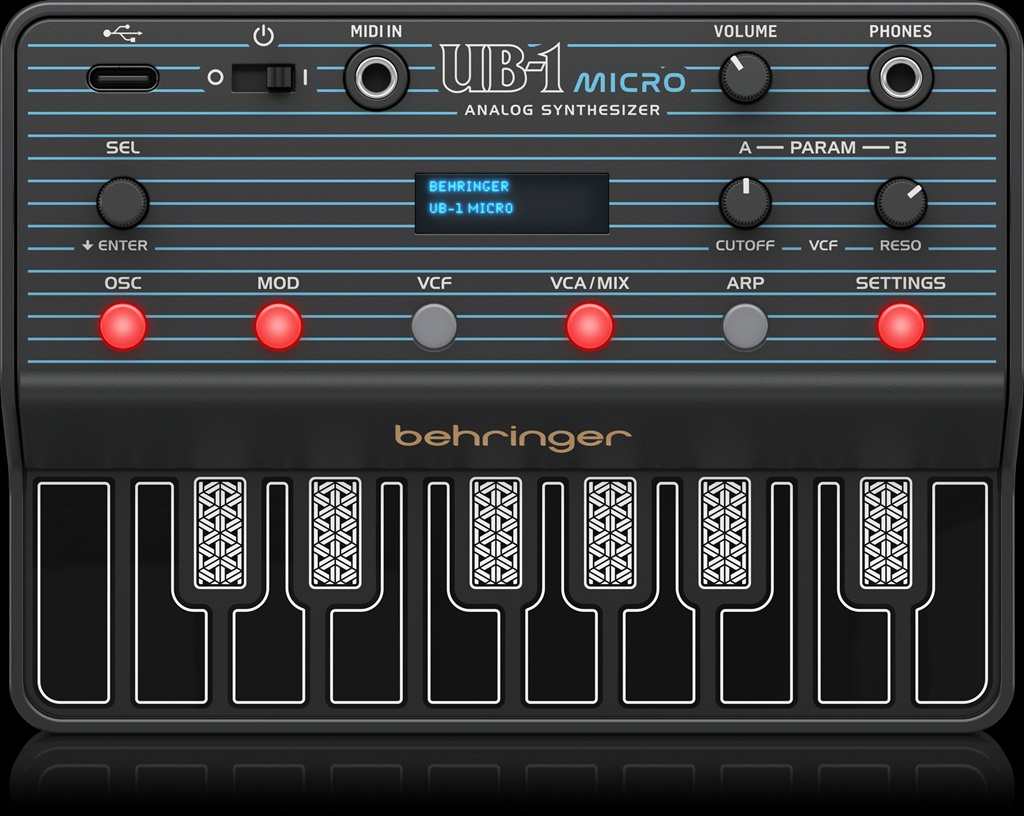
With the Behringer UB-1 MICRO, Behringer introduces an ultra-compact, fully programmable analog synthesizer designed to deliver classic 1980s synth textures anytime, anywhere. Whether you’re on the couch, traveling, or quickly sketching ideas in the studio, the UB-1 MICRO aims to be a true grab-and-go analog instrument.
At the core of the synth is a legendary 3396/3397 analog chip design, famously associated with instruments like the Oberheim Matrix-6 and Matrix-1000. This heritage is combined with a dual-DCO architecture, a dedicated sub-oscillator and noise generator, and a classic 4-pole low-pass filter, forming a sound engine clearly rooted in vintage analog tradition.
Key Features at a Glance
Behringer positions the UB-1 MICRO as small in size, but serious in capability, focusing on immediacy, portability, and everyday usability:
- Two DCOs plus sub-oscillator and noise source
- Classic 4-pole VCF
- 16 velocity-sensitive touch keys
- 32 user-programmable presets (editable via the SynthTribe app)
- Arpeggiator with three patterns and hold mode
- Separate envelopes for filter (VCF) and amplifier (VCA)
- Two LFOs for modulation of filter and oscillator tuning
- Six function buttons and an OLED display for fast parameter access
- USB-C power (smartphone charger, power bank, or computer)
- Comprehensive USB/MIDI support, including full CC control and bulk load/save
What Does This Mean Musically?
The combination of dual DCOs, sub-oscillator, noise, and a 4-pole low-pass filter is a proven formula for punchy basslines, expressive leads, and tight, percussive arpeggios. What makes the UB-1 MICRO particularly interesting is its deliberate nod toward iconic 80s analog character, achieved through the 3396/3397-style architecture, while still offering a thoroughly modern workflow thanks to patch memory, USB-MIDI, and app-based programming.
Studio and Mobile Workflow: Small but Fully Connected
From a practical standpoint, USB-C power makes it genuinely easy to take the UB-1 MICRO anywhere without special power supplies. Combined with MIDI-over-USB and full CC automation, the synth goes beyond being a simple sketch tool—it integrates cleanly into DAW projects, controller setups, and template-based workflows.
Behringer also highlights compatibility with external MIDI controllers for improved playability, specifically mentioning the option to connect a Behringer SWING keyboard for a more traditional performance experience.
Conclusion
The UB-1 MICRO presents itself as a focused portable analog concept: classic synthesis fundamentals (DCOs, 4-pole filter, envelopes) meet modern conveniences such as OLED navigation, preset storage, USB-C power, and deep USB-MIDI integration. Anyone looking for a compact instrument dedicated to 80s-inspired analog sounds, quick idea generation, and seamless DAW integration should keep a close eye on this micro-format synth.
I